
Shi vs tsu and so vs n: how to tell シ ツ ソ ン apart
By Ari Nakos · Published 21 October 2026 · Updated
The short answer: look at the long stroke. In シ (shi) and ン (n) it starts low on the left and rises to the upper right. In ツ (tsu) and ソ (so) it starts at the top and falls to the lower left.
| Katakana | Reads | Strokes | Long stroke | Hiragana twin |
|---|---|---|---|---|
| シ | shi | 3 | rises to the upper right | し |
| ツ | tsu | 3 | falls to the lower left | つ |
| ン | n | 2 | rises to the upper right | ん |
| ソ | so | 2 | falls to the lower left | そ |
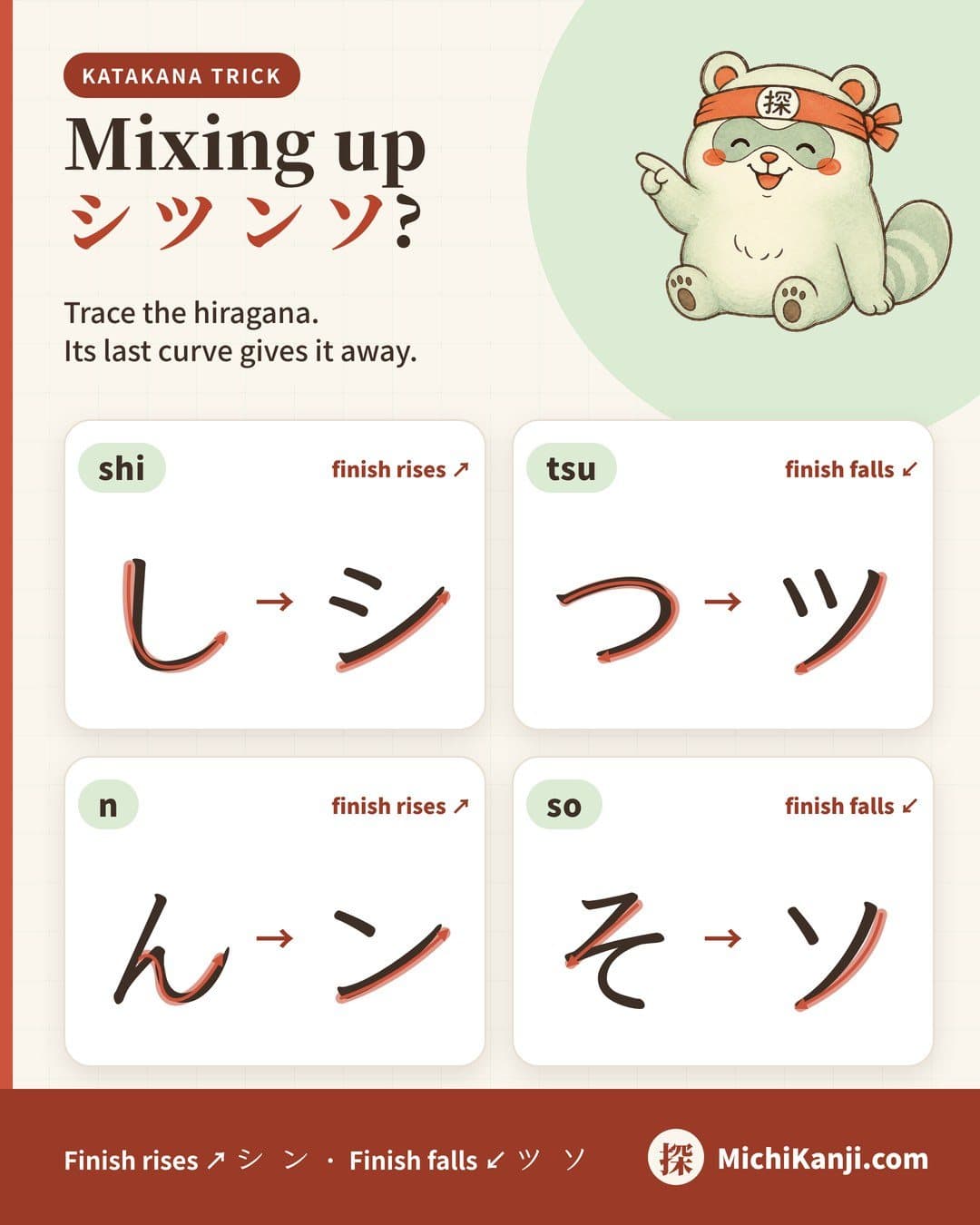
How do you tell シ from ツ and ソ from ン?
Each of the four ends on one long stroke, and the direction of that stroke is the whole trick: シ and ン rise, ツ and ソ fall.
Your hiragana already show it. し and ん both finish by sweeping up to the right. つ ends curling down to the left, and the diagonal at the top of そ falls the same way as the long stroke of ソ.
Can the dots help? Two backup clues
- シ vs ツ. シ has two dots stacked one above the other, lying fairly flat. ツ has two dots side by side on top, standing more upright, like two ticks above the long stroke.
- ン vs ソ. ン has one flat dot in the upper left, and its long stroke starts low. ソ has one upright dot, and its long stroke starts high, right beside it.
How do we know the long-stroke rule holds?
We did not judge it by eye. On we read the direction of each long stroke from the stroke data of the KanjiVG project (CC BY-SA 3.0): the long stroke of シ and ン runs from the lower left to the upper right, and that of ツ and ソ from the top to the lower left.
Where it can fail: handwriting is often loose, even for native writers. When in doubt, read the whole word. A loanword such as ツナ or パン is easy to guess from context.
Is it really the same shape as the hiragana?
Can you read these six words?
Say each one in your head, then open it to check.
ツナ
tsuna — tuna
シーツ
shītsu — bed sheets
ソファ
sofa — sofa
パン
pan — bread
シーソー
shīsō — seesaw
ツアー
tsuā — tour
Want more than six words? Take the 10-question katakana quiz.
How do you practise them?
Writing the long stroke the right way is the fastest fix. Print free katakana practice sheets with stroke order.
Mixing up other similar kana too? ナ vs メ: look for the flat bar, or ぬ vs め (hiragana): does the tail loop?.
Questions people ask
- Why do シ and ツ look so alike?
- Both are two short strokes plus one long sweep. They come from different kanji (シ from 之, ツ from 川), but they ended up with the same parts, so only the angle of the strokes differs.
- What is the difference between シ (shi) and ツ (tsu)?
- シ is shi: the two dots are stacked on the left and the long stroke rises to the upper right. ツ is tsu: the two dots sit side by side on top and the long stroke falls to the lower left.
- How do you tell ソ (so) from ン (n)?
- The same rule. ン (n) has one flat dot and a long stroke that rises to the upper right. ソ (so) has one upright dot and a long stroke that falls from the top to the lower left.
- What if handwriting is messy?
- Native handwriting is often loose too. Read the whole word: a loanword such as ツナ or パン is easy to guess from context, and that is how most readers settle it.