
Lookalike kana: how to tell them apart
Some kana are easy to confuse until you know the one thing to look for. This page takes the pairs one at a time, each with a rule you can check on the shapes themselves.
- ナ vs メ: look for a flat bar.
- シ vs ツ and ソ vs ン: follow the long stroke (its own page).
ナ vs メ: is there a flat bar?
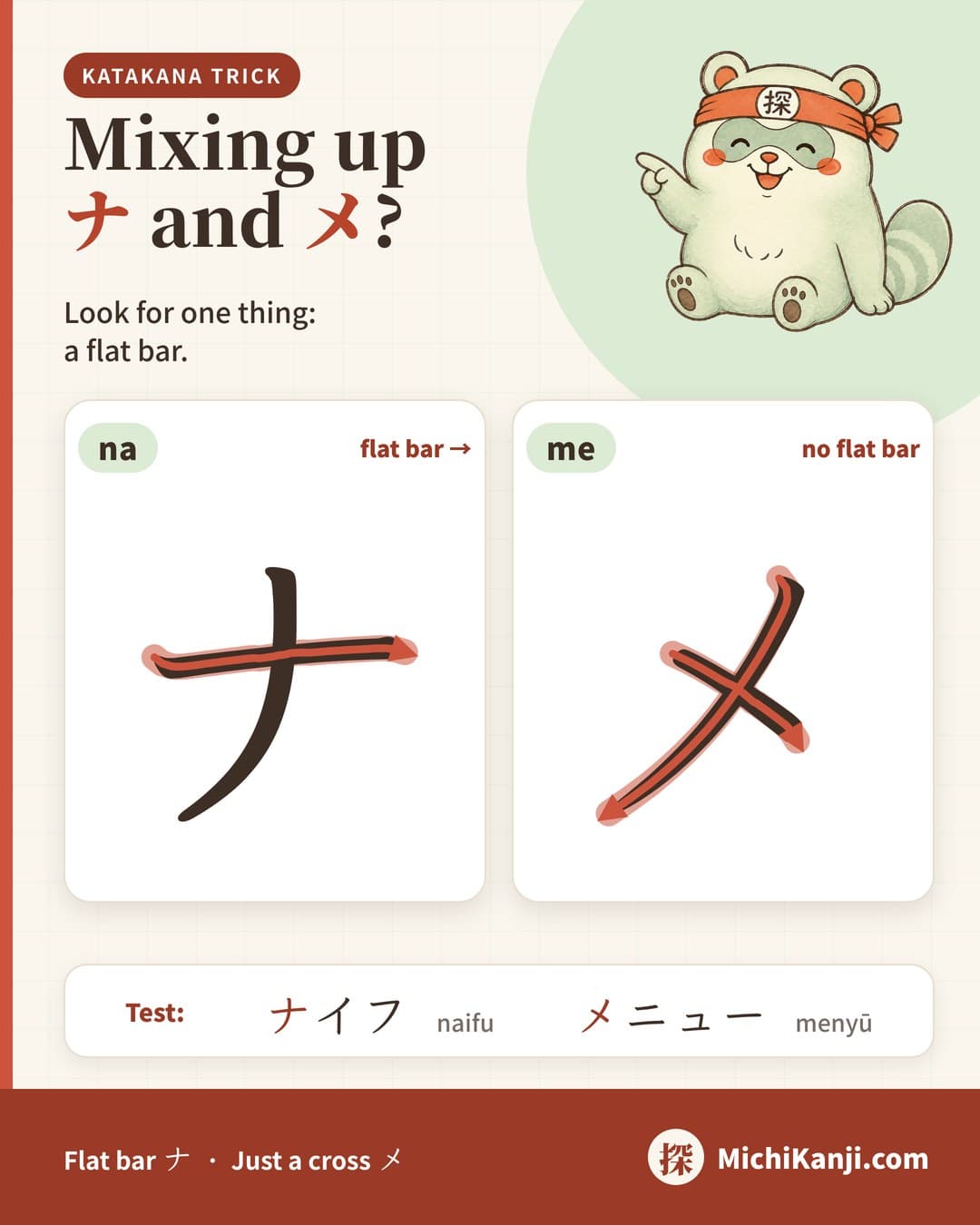
ナ (na) starts with a flat bar drawn left to right, and then one stroke hangs down from it and sweeps to the lower left. メ (me) has no flat line anywhere. Its two strokes are both diagonals: one runs from the upper right down to the lower left, the other from the upper left down to the lower right, and they cross.
So the check takes one second: find a horizontal line. If there is one, it is ナ. If all you see is an X, it is メ.
| Katakana | Reads | Strokes | First stroke | Shape |
|---|---|---|---|---|
| ナ | na | 2 | a flat bar, left to right | a bar with one stroke hanging down from it |
| メ | me | 2 | a diagonal, top right to lower left | two diagonals crossing, no flat line |
Does the rule always hold?
We checked it on the shapes, not by eye. In the stroke data for the two characters, the bar of ナ is within a few degrees of horizontal, while both strokes of メ lean at least 39 degrees away from it. We also measured the longest unbroken horizontal run of ink in four fonts (a calligraphy pen face, a brush face, a gothic and a mincho). In every one, ナ has a run covering nearly its full width, and メ never gets past half of its width, which is only the crossing point.
Where it can fail: a rushed hand-written ナ can slant its bar, and a very bold メ can show a short flat patch where the strokes cross. When in doubt, read the whole word.
Unlike シ and ツ, the hiragana twins do not help here: な and め are more complicated shapes and do not show the same split.
Where they come from
な and ナ both come from the kanji 奈, and め and メ both come from 女. That is history, not a memory aid: it does not explain the flat-bar rule.
Test yourself: read these six words
Say each one in your head, then open it to check.
ナイフ
naifu — knife
メニュー
menyū — menu
ナース
nāsu — nurse
メール
mēru — email
メモ
memo — note, memo
ナンバー
nanbā — number
Want more than six words? Take the 10-question katakana quiz.
Practise them on paper
Drawing the bar first, then the long stroke, is the fastest fix. Print free katakana practice sheets with stroke order.
Questions people ask
- How do I tell ナ from メ?
- Look for a flat bar. ナ (na) is built on a horizontal bar with one stroke hanging down from it. メ (me) has no flat line at all: it is two diagonal strokes that cross, like an X.
- Why do ナ and メ get mixed up?
- Both are two strokes that cross near the middle, and both have a stroke that sweeps down to the lower left. Only the first stroke differs: flat in ナ, diagonal in メ.
- Do the hiragana な and め help, as they do for シ and ツ?
- Not here. な and め are more complicated shapes and do not show a clean flat-bar difference, so this page uses the katakana shapes themselves.
- What if the handwriting is messy?
- A hurried ナ can have a slanted bar, and a bold メ can look as if it has a short bar where the strokes cross. Read the whole word: ナイフ or メニュー is easy to guess from context.